

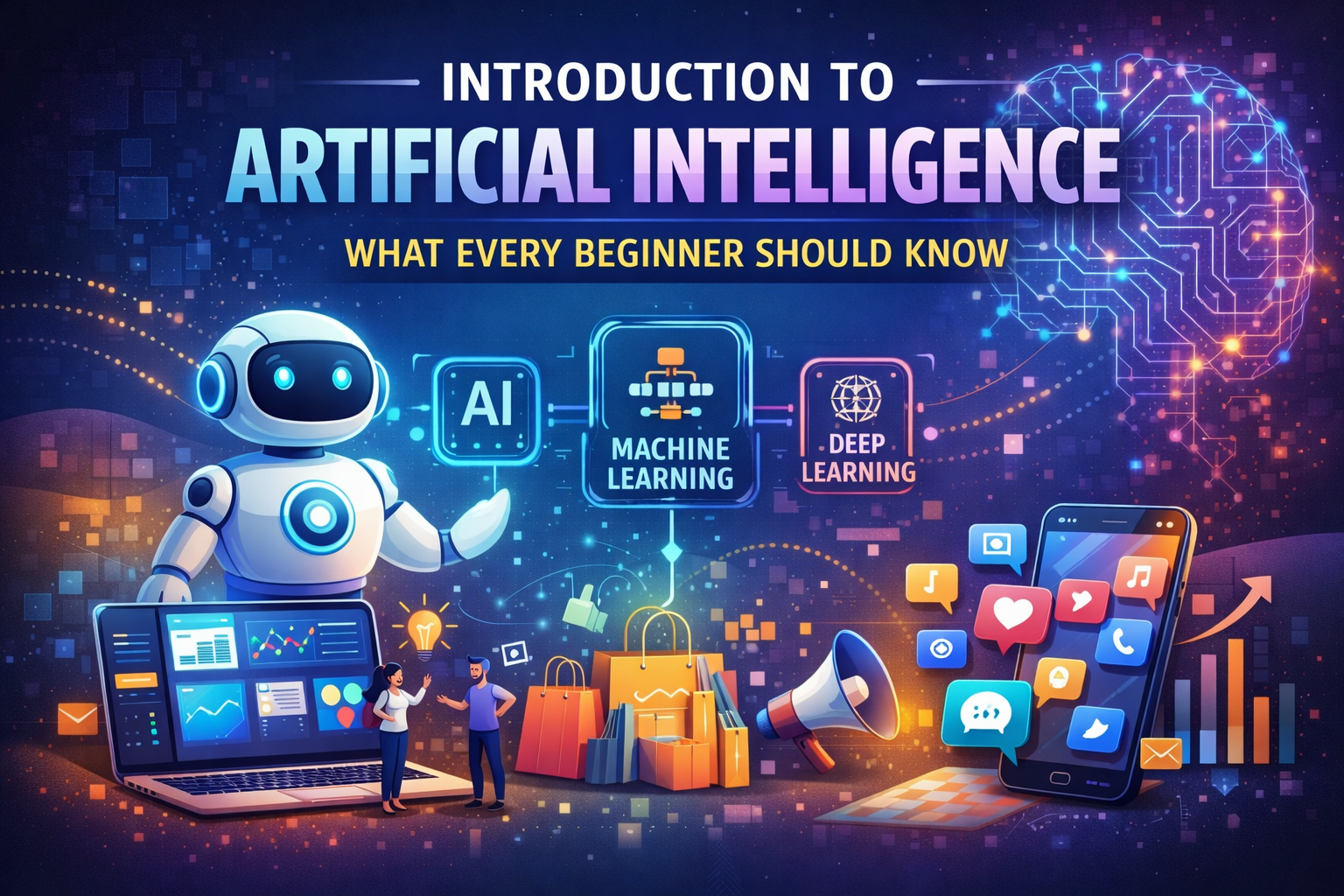
Artificial Intelligence, often shortened to AI, is one of the most talked-about technologies in the world today. You hear about it in marketing, software development, smartphones, cars, banking, healthcare, and even everyday apps you use without thinking twice. For many beginners, however, AI sounds mysterious, overly technical, or reserved for advanced programmers and scientists.
The truth is much simpler. Artificial Intelligence is not magic, and you do not need to be a mathematician or engineer to understand its foundations. This guide is written to help you clearly understand what AI is, how it works at a basic level, how machine learning and deep learning fit into the picture, and how AI is already being used in marketing, software, and everyday tools you interact with daily.
By the end of this article, AI will feel less intimidating and more like a practical technology shaping the digital world around you.
What Is Artificial Intelligence in Simple Terms?
Artificial Intelligence refers to the ability of machines or software systems to perform tasks that normally require human intelligence. These tasks include learning from experience, recognizing patterns, understanding language, making decisions, and solving problems.
When a computer system can analyze data, learn from it, and improve its performance without being explicitly programmed for every situation, that system is using AI. Instead of following rigid instructions, AI systems adapt based on information.
For example, when YouTube suggests videos you might like, when Google completes your search query, or when your email filters spam automatically, AI is working behind the scenes. These systems observe patterns in data and make intelligent predictions.
Understanding the Relationship Between AI, Machine Learning, and Deep Learning
One of the most common sources of confusion for beginners is the difference between Artificial Intelligence, Machine Learning, and Deep Learning. These terms are related, but they are not the same.
Artificial Intelligence is the broad concept. It refers to any system designed to simulate human intelligence. Within AI, there are different methods and approaches for achieving this goal.
Machine Learning is a subset of AI. It focuses on teaching machines how to learn from data rather than relying solely on fixed rules. Instead of programming every possible outcome, developers feed data into algorithms that learn patterns and make predictions.
Deep Learning is a further subset of Machine Learning. It uses structures called neural networks, which are inspired by the human brain. These networks process large amounts of data through multiple layers, allowing systems to recognize complex patterns such as images, speech, and natural language.
In simple terms, Artificial Intelligence is the big idea, Machine Learning is how machines learn from data, and Deep Learning is a powerful technique used for more complex learning tasks.
How Machine Learning Actually Works
At its core, machine learning works by analyzing data and finding patterns. The system is trained using examples. Over time, it becomes better at making predictions or decisions based on new information.
Imagine you want a system to recognize whether an email is spam or not. You provide thousands of examples of emails labeled as “spam” or “not spam.” The machine learning model studies these examples, learning which words, phrases, and patterns are commonly associated with spam. Once trained, it can analyze new emails and classify them correctly.
This learning process improves as more data becomes available. The more high-quality data the system sees, the more accurate it becomes.
What Makes Deep Learning Different?
Deep learning takes machine learning a step further by using multiple layers of artificial neurons. Each layer processes information at a different level of abstraction.
For example, in image recognition, the first layer may detect simple edges and shapes. The next layer might identify patterns like eyes or wheels. Higher layers combine these features to recognize complete objects such as faces or cars.
This layered approach allows deep learning systems to handle highly complex tasks that traditional programming cannot easily solve. This is why deep learning powers technologies like voice assistants, facial recognition, and advanced language models.
Practical Applications of AI in Digital Marketing
Artificial Intelligence has transformed digital marketing in powerful ways. Instead of guessing what customers want, businesses can now rely on data-driven insights.
AI helps marketers understand customer behavior by analyzing large volumes of data. It can identify patterns in browsing history, purchase behavior, and engagement, allowing businesses to deliver personalized experiences. This is why you often see ads or recommendations that feel surprisingly relevant.
AI also improves advertising efficiency. Platforms like Google Ads and Meta Ads use AI to automatically optimize campaigns, adjust bidding strategies, and target the most responsive audiences. This allows even small businesses to compete more effectively with limited budgets.
Content creation and optimization have also benefited from AI. Marketers use AI tools to generate ideas, optimize headlines, analyze SEO performance, and predict which content is likely to perform best. This does not replace human creativity but enhances it.
AI in Software Development and Technology
In software development, AI has become a powerful assistant rather than a replacement for developers. AI-powered tools help write code, detect bugs, improve security, and automate repetitive tasks.
For beginners, this means learning software development is becoming more accessible. AI tools can explain code, suggest improvements, and reduce errors, allowing developers to focus on problem-solving and logic rather than memorizing syntax.
AI is also used in software testing and maintenance. Systems can detect anomalies, predict system failures, and optimize performance before problems occur. This makes applications more reliable and efficient.
In enterprise systems, AI supports decision-making by analyzing trends, forecasting demand, and optimizing workflows. Businesses rely on these insights to improve productivity and reduce costs.
AI in Everyday Tools You Already Use
You do not need to work in tech to benefit from Artificial Intelligence. AI is already embedded in everyday tools that millions of people use.
Smartphones use AI for facial recognition, camera enhancements, voice assistants, and predictive text. Navigation apps analyze traffic patterns in real time to suggest faster routes. Streaming platforms recommend movies and music based on your preferences.
Email platforms use AI to filter spam, suggest replies, and organize messages. E-commerce platforms personalize shopping experiences and predict what you might want to buy next.
Even simple tools like grammar checkers and translation apps rely heavily on AI to understand language and context.
Is Artificial Intelligence Dangerous or Something to Fear?
Many beginners worry that AI will replace jobs or become uncontrollable. While AI does automate certain tasks, it also creates new opportunities and roles. History shows that technology shifts work rather than eliminates it entirely.
AI is best viewed as a tool. Like any tool, its impact depends on how humans choose to use it. Ethical AI development, transparency, and responsible use are important conversations, but fear should not stop learning.
Understanding AI gives you an advantage. Those who learn how to work with AI, rather than ignore it, will be better positioned in the digital economy.
Why Beginners Should Start Learning About AI Now
Artificial Intelligence is no longer a futuristic concept. It is a present-day reality shaping industries and careers. Whether you are interested in digital marketing, software development, business, or general technology, understanding AI fundamentals will help you make better decisions.
You do not need to start by building complex models. Learning how AI works conceptually, how it is applied, and how to use AI-powered tools is enough to get started.
This foundation is your first step into a smarter digital future.